

Why waste $185,000 on a Master Plan when we know the problems and have the answers
- Mike Lednovich
- Mar 1
- 4 min read


Commentary
By Mike Lednovich/Editor
Before writing that $185,000 check, the Fernandina Beach City Commission should answer a simple question: what, exactly, will this plan tell us that we don't already know?
This city is not suffering from a shortage of parks. It has Central Park, neighborhood parks scattered across the island, Ron Sapp Egan's Creek greenway, beachfront access points, the Atlantic Recreation Center, MLK Rec Center, the Peck Center, youth ballfields and, as of April 1, the long-awaited waterfront park along the Amelia River. That signature project — years in the making — is just now opening.
And yet, we are told we need another master plan that will take two years to complete.
Fernandina Beach already has a 2015 blueprint, and it has gathered dust with ambitious goals that went unfunded.
In 2015, the city adopted its Parks and Recreation Master Plan that was thick with beautiful renderings and long on vision. It promised transformative projects:
A new civic center at Central Park.
An aquatics center with a lazy river, expanded gym space and pickleball courts at the Atlantic Recreation Center.
Conversion of Ybor Alvarez into the Fernandina Beach Sports Complex, complete with competition-level facilities for baseball, softball, soccer, football and lacrosse.
And, in perhaps its most grandiose flourish, the “Avenida de las Banderas” — a two-mile, trolley-served corridor lined with the eight national flags that once flew over Fernandina, shaded by trees, with broad sidewalks and bike lanes connecting the waterfront park to Central Park to the proposed Aquatics Center to Main Beach.
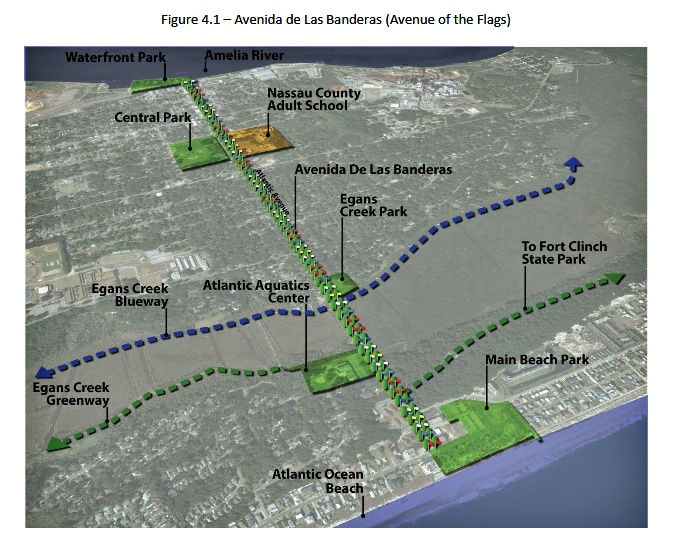
None of it happened.
Not because the ideas were hidden. Not because consultants failed to gather enough public input. Not because residents didn’t understand the need for recreation.
It failed because master plans do not build facilities. Money does. Political will does. Stable governance does.
And in Fernandina Beach, city commission seats turn over every two years. Priorities shift. Economic realities intrude. Budgets tighten. Grand visions become line items deferred “until funding becomes available.”
The city's needs are obvious and have been identified and discussed ad nauseum.
If residents want more recreation opportunities, the most urgent and obvious gap is youth soccer fields.
Parents do not need a $185,000 consultant report to tell them that local children are short on field space.
The choices are straightforward:
Purchase the FAA-controlled land at the existing Ybor Alvarez site and build there; or
Clear city-owned wooded property adjacent to the municipal golf course and develop new field; or
Reduce the 27-hole city golf course to 18 holes to accommodate a soccer complex.
Those are policy decisions — not planning mysteries.
Similarly, the Atlantic Recreation Center and other facilities need upkeep and modernization. Roofs, HVAC systems, resurfaced courts, upgraded lighting — these are maintenance realities. They do not require a visionary corridor with festive trolleys.
They will require funding discipline.
A new $185,000 master plan won't provide the answer to the most pivotal question - where will the money come from?
The city is considering a $30 million+ bond to finance a riverfront flood protection wall and renovation of historic downtown. To pay the bond, the city is committing revenue from its controversial downtown paid parking program.
So, where will the additional money come from for parks and recreation improvements?
Fernandina Beach is already juggling infrastructure demands, stormwater projects, waterfront investments, and operating pressures. The city has repeatedly faced tight budgeting cycles.
Spending $185,000 on another consultant-driven master plan risks repeating the cycle of 2015: a glossy document, a public presentation, applause — and then shelving it when funding proves elusive.
Master plan execution always depends on a City Commission willing to fund it. In a city where elections every two years can shift the political balance, long-range capital commitments become fragile.

It is fiscally imprudent to commission another visionary roadmap without first demonstrating the ability — and financial capacity — to carry out the last one.
And elaborate plans do not automatically equal progress.
Fernandina Beach does not suffer from a lack of imagination. It suffers from a mismatch between aspiration and resources.
The waterfront park opening April 1 stands as proof that focused investment can deliver results. But it also underscores a key point: major projects take years of sustained political and financial commitment.
Before authorizing another $185,000 study, commissioners should instead:
Prioritize land acquisition or site selection for soccer fields.
Develop a clear capital maintenance plan for existing recreation facilities.
Publish a realistic, phased funding strategy tied to actual revenue projections.
Evaluate why the 2015 recommendations were not implemented — and what has changed.
If the answer is “nothing,” then the folly is not in the lack of planning. It is in pretending that another plan will solve a funding problem.
Fernandina Beach has plenty of parks. It has facilities. It has a brand-new waterfront showpiece about to open.
What it needs now is not another glossy master vision — but disciplined execution of practical, achievable improvements.
A city that cannot afford to build its dreams should not spend scarce dollars rewriting them.


Comments