

The Roots of Paid Parking: How Bean-Era Budget Decisions Created the Current Funding Crisis
- Mike Lednovich
- Aug 30
- 8 min read


Commentary
FERNANDINA BEACH - Paid parking in Fernandina Beach did not begin when parking signs appeared downtown.
It did not begin when this City Commission approved a parking contractor.
And it did not begin when the commission ultimately imposed it.
The origins of paid parking were spawned years earlier, during the 2023-24 City Commission led by then-Mayor Bradley Bean, and then financial problems continued into the 2024-25 budget.
While Bean and Commissioners Darron Ayscue and David Sturges didn’t erect the parking signs, they created the funding crisis that manifested its need.
And that’s where paid parking saga eventually took root.
Over two key budget cycles, Bean's administration repeatedly confronted the same uncomfortable equation: The city had more infrastructure funding needs and operating expenses than available revenue.
Yet Bean, Ayscue and Sturges made decisions that reduced city revenue and limited its growth.
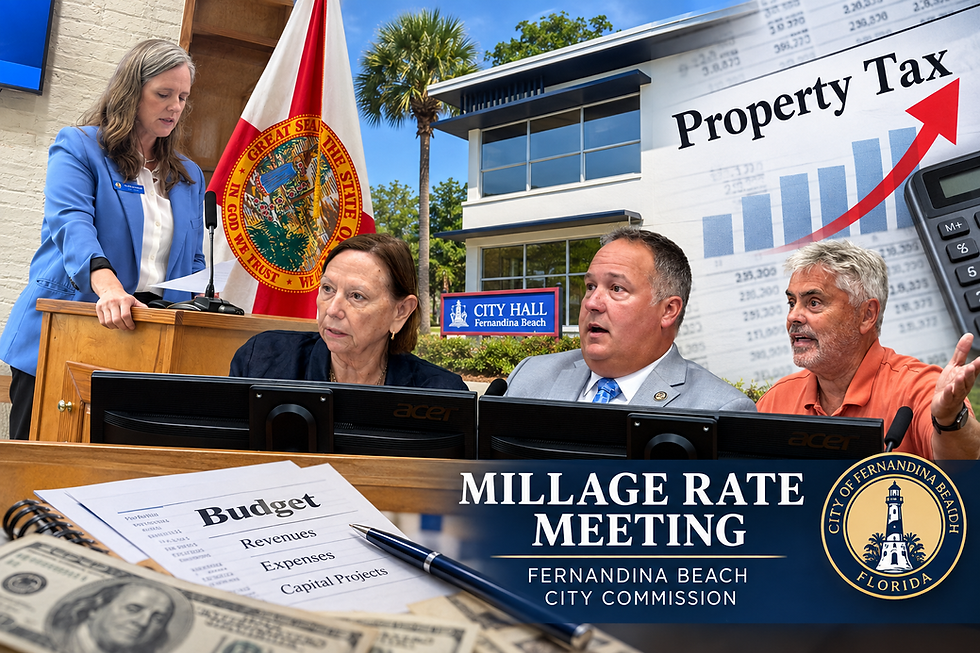
They lowered the property-tax millage rate despite warnings about the consequences for capital improvements.
They cut capital spending to make the lower tax rate work.
They did so while the city already knew major bills were coming, including the future of the deteriorating Brett’s Waterway Cafe building and the city marina, along with streets, sidewalks, recreation facilities, beach walkovers, downtown infrastructure and other projects.
And while those commissioners were cutting capital spending in the name of fiscal restraint, they increased their own salaries by 50%.
Then, when presented with a new professional study showing that the city should be collecting substantially more - $1 million or more annually - from new construction to pay for future water and sewer capacity, Bean, Ayscue and Sturges went in the opposite direction and lowered that fee.
They dragged their feet on acquiring the Ybor Alvarez soccer fields for $3.4 million - half to be paid for by Nassau County. That bill is now approaching almost $8 million with no county funding.
None of those decisions alone created paid parking.
But taken collectively, and compounded by another difficult budget the following year, they helped create the fiscal conditions that made paid parking as the lone alternative when the succeeding commission went looking for money.
The story begins in the summer of 2023.
City officials had warned commissioners what adopting the rollback property-tax rate would mean. Keeping the previous year's millage rate would have generated roughly $2.2 million more in property-tax revenue.
But Bean, Ayscue and Sturges voted to lose the $2.2 million and lower taxes.
However, the city couldn’t simply eliminate $2.2 million in potential revenue without consequences. City operating expenses were increasing, resulting in much of the reduction having to come from capital spending.
That meant projects involving streets, sidewalks, recreation facilities, beach walkovers, downtown improvements and other city infrastructure were placed on the chopping block.
At the same time, Bean's commission could look just a few blocks from City Hall and see another major financial obligation looming on the waterfront: Brett’s Waterway Cafe.

The city-owned building had been the subject of structural concerns and years of debate about its future. Whatever solution commissioners ultimately chose, the waterfront problem wasn’t going to solve itself for free.
The marina itself also required significant investment.
These weren’t hypothetical needs dreamed up by a future commission. They were problems sitting in front of Bean, Ayscue and Sturges while they were deciding how much revenue the city should collect.
Nevertheless, the commission voted 3-2 to move forward with the rollback rate of 4.8298 mills.
Bean championed the tax reduction.
“Going back to the rollback for the first time in over a decade.”
He then thanked the commission for its “leadership to go back to the rollback rate.
The previous operating millage rate had been 5.3330 mills. The rollback decision represented a 9.4% reduction in the tax rate.
There is an important distinction here. Because property values were rising and new construction was being added to the tax rolls, the city wasn’t necessarily collecting fewer property-tax dollars than it had the previous year.
But it was deliberately choosing to collect substantially less than it would have received by maintaining the existing millage rate.
And Bean, Ayscue and Sturges knew where much of the difference would come from: capital improvements.
Then came a decision that made the commission’s priorities particularly difficult to reconcile.
While cutting capital improvements to achieve the rollback rate, commissioners increased their own salaries by 50%.
Whatever argument could be made that commissioners deserved higher compensation, the timing matters.
Meanwhile, Brett’s wasn’t getting any younger.
The marina wasn’t fixing itself.
The streets weren’t resurfacing themselves.
The capital bills weren’t disappearing.
Perhaps the most revealing moment of the rollback debate came from Commissioner James Antun.
Antun said that if commissioners adopted the rollback, they needed to become serious about finding “other potential revenue opportunities.”
One of the alternatives he specifically mentioned?
Paid parking.
That was 2023.
Years before the parking signs appeared downtown, the connection had already been made.
Reduce one source of revenue, and sooner or later the city had to find another.
The seed had been planted.
Property taxes weren’t the only place where Bean’s commission chose the lower-revenue path.
Consider what happened with water and sewer capacity fees.
A capacity fee is a one-time charge imposed on new residential and commercial construction connecting to the city’s water and sewer system. The money helps reimburse the Utility Department for the capital costs necessary to provide the additional capacity to serve those new customers.
Fernandina Beach’s existing fee was based on a study dating to 2015.
The city obtained a new study from the Florida Rural Water Association using an entirely new methodology and updated metrics that reflected substantially higher material, labor and system replacement costs.
At the time, the city charged $3,280 for a newly constructed home.
The new study supported a fee of $10,040.
The Northeast Florida Builders Association vigorously opposed the increase.
The commission had several choices.
It could adopt the updated $10,040 fee and generate more than $1 million annually.
It could phase the increase in over several years.
It could leave the existing $3,280 charge in place.
Instead, commissioners lowered it to $3,000.
Think about that. That vote has cost the city an estimated $3 million.
The capacity-fee decision and the rollback decision involved different pots of money. Capacity fees are restricted to legally permissible utility capital expenses and could not simply have been spent on Brett’s, downtown improvements, the waterfront or other general-fund projects.
But they illustrate the choices the commission was making as costs continued to climb.
Lower the millage.
Cut capital improvements.
Raise commissioners’ salaries by 50%.
Lower the capacity fee charged to new construction despite a new study supporting a dramatically higher amount.
Do all of that while knowing major capital bills are coming.
Then confront those same needs with less revenue available to address them.
Lowering a tax rate doesn’t repave a street.
Cutting a capital project doesn’t eliminate the need for the project.
Lowering a capacity fee doesn’t make utility expansion cheaper.
And lowering the millage didn’t make Brett’s disappear from the waterfront.
Then came the 2024-25 budget.
If anyone believed the previous year’s cuts had solved the city’s financial problem, the next budget quickly demonstrated otherwise.
Once again, the starting point was that there wasn’t enough money to pay for everything Fernandina Beach needed.
It was also an election year. Bean and Vice Mayor David Sturges were seeking another term on the commission, putting another property-tax decision before commissioners just months before voters went to the polls.
Interim City Manager Jeremiah Glisson presented a staff recommendation for a “modified rollback rate.”

The proposal would protect homesteaded property owners while generating about $580,000 more than a full rollback rate.
Even the modified rollback proposal represented another 3% reduction in the millage rate from the previous year and was projected to generate $19.4 million.
Glisson laid out what the proposed budget could fund.
There was $955,000 for streets and sidewalks.
There was $572,862 for improvements to the Atlantic Recreation Center.
There was $2 million for the waterfront seawall, supported by a state grant.
There was $630,000 for Amelia Island Lighthouse work, also supported by a state grant.
There was $125,000 for City Hall improvements.
There was more than $1.2 million for downtown revitalization and improvements.
And there was $935,288 for police and fire radios.
But the more revealing part of Glisson’s presentation was what the city still could not adequately fund.
Street resurfacing was falling further behind.
The proposed budget contained $230,000 less for resurfacing than the previous year.
“We need to address how we’re going to pave those,” Glisson told commissioners.
There was no money for additional firefighters despite previous commission support for increasing public-safety staffing.
“This is something we need to talk about,” Glisson said. “There was commission support to fund the increase in public safety. This budget does not have this money for the firemen.”
There was no funding for additional beach-boardwalk replacements, even though the Beach Access Committee had recommended in 2021 that at least three beach walkovers be constructed in 2025.
Maintenance expenses for city buildings and property were increasing.
The city was adding 6.5 employees even though departments had requested 16.5.
Personnel costs were projected to increase 9.8% for the city’s 296 full-time employees.
And then there were the city enterprises requiring help from the general fund.
The municipal golf course was budgeted to receive an $890,000 subsidy.
“Increasing expenses without corresponding revenues is putting the golf course in a deficit,” Glisson warned.
The marina required another $686,000 transfer.
Together, the golf course and marina were projected to require nearly $1.6 million in support.
That was money unavailable for other general-fund needs.
Meanwhile, the backlog kept growing and Bean, Ayscue and Sturges - the ruling majority - had a decision to make.
The commission could reduce the tax rate.
It could postpone spending.
It could use reserves.
But it could not repeal the underlying costs.
Again, they chose less revenue.
Fast forward to the February 2025 goal-setting workshop, the new commission identified paid parking as an alternative funding source for “overdue capital improvement projects.”
Those four words tell much of this story:
“Overdue capital improvement projects.”
The very category of spending that had taken the brunt of the 2023 rollback decision — and remained under pressure during the 2024-25 budget — was now being cited as a reason the city needed another source of revenue.
Paid parking offered one.
The political proposition was straightforward: Rather than obtain all the money through property taxes, make visitors and downtown users help finance downtown and waterfront improvements by paying to park.
And eventually the connection between those old capital obligations and paid parking became tangible.
Paid-parking revenue was committed to the demolition of Brett’s and the reconfiguration of the city marina.
That matters because Brett’s did not suddenly become a problem when paid parking arrived. The project has doubled in scope - from $6 million to $12 million - the most costly project in the city's history.
The city knew years earlier that the building and waterfront represented a major financial obligation.
Bean’s commission knew it.
And, government decisions don’t occur in isolation.
The city had spent two budget cycles postponing critical financial obligations.
And eventually, the road reached a downtown paid parking program.
Fast-forward to 2026.
Paid parking became one of the most divisive issues Fernandina Beach has seen in years.
The program went into effect.
Residents organized against it.
On Aug. 18, voters overwhelmingly rejected paid parking in a referendum.
The following day, the City Commission voted 4-1 to terminate the program.
And now it will no longer have the paid-parking revenue that was supposed to help pay for some of those needs.
That is why the history matters.
The lesson of paid parking isn't simply that voters don't like paying to park downtown.
It is that municipal finance has consequences.
You can lower taxes.
You can lower fees.
You can postpone capital projects.
You can celebrate each of those decisions individually.
But you cannot repeal arithmetic.
Eventually somebody has to pay and now it's on the backs of city taxpayers.


Too bad this wasn't explained before paid-parking was enacted. Then again, many think the MAGA thugs on the past commission can do no wrong. They orchestrated the anti paid parking animosity and now are planning to take over future commissions. As the MAGA spokesperson Aysque fought against paid parking to look like the "good guy" while knowing full well he and his fellow procrastinators had caused the damage without facing the consequences. He's bragged about "taking over" in various Facebook posts. He has never acknowledged past mistakes. Thanks Mike for pointing out the facts that have been covered up for too long.