

Paid Parking Is Gone. Fernandina Beach Turns to Property Taxes to Shore Up Budget
- Mike Lednovich
- 4 days ago
- 4 min read

By Mike Lednovich/Editor
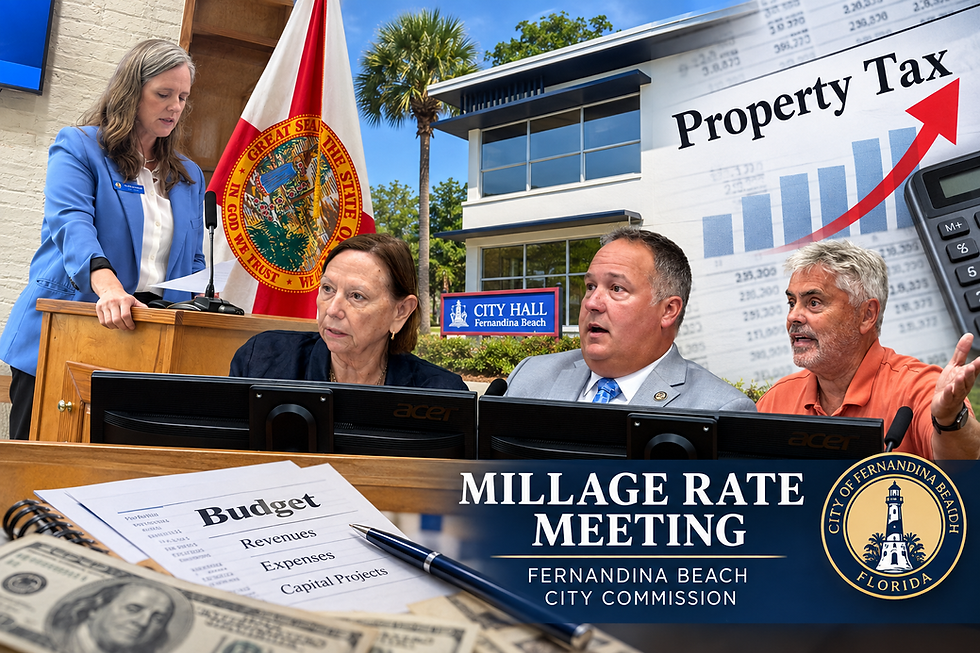
FERNANDINA BEACH - City commissioners voted 4-1 Thursday to tentatively raise the city’s property tax rate 9.24% above the rolled-back rate, a move designed to help make up for the loss of paid-parking revenue and protect city finances against a potentially steep drop in property tax revenue if voters approve a statewide measure Nov. 3.
The commission approved a tentative operating millage rate of 4.8530 mills for the 2026-27 fiscal year. Vice Mayor Darron Ayscue cast the lone dissenting vote. The rolled-back rate, which would generate roughly the same property tax revenue as the current year after accounting for new construction, is 4.4425 mills.
The higher rate would generate about $1.5 million more than the budget City Manager Sarah Campbell initially proposed. Commissioners directed that money be set aside rather than spent, giving the city a financial cushion while it waits for the Nov. 3 vote.
The city is confronting the two revenue threats at the same time.
The commission terminated its controversial paid-parking program after 75% of voters rejected it in the Aug. 18 referendum. The city had planned to use $1.5 million in paid-parking revenue for marina and waterfront capital improvements. The revised budget replaces that money with $668,000 remaining in the paid-parking fund and an $832,000 transfer from the general fund.
The November property tax measure presents a potentially much larger problem. Commissioner Genece Minshew said during Thursday’s hearing that the measure could cost the city $4 million or more in property tax revenue if approved.
“This is not about finding another $1.5 million to spend,” Minshew said. “This is about whether this commission is willing to look beyond the next 12 months and prepare for what might be coming.”
Minshew said ending paid parking did not eliminate the infrastructure expenses the parking revenue was intended to pay.
“The waterfront still needs to be completed,” she said. “Our infrastructure still needs attention. Our facilities still need investment.”
The city also faces debt service on a $7.7 million line of credit for waterfront-related work.
“These obligations did not disappear on election night,” Minshew said.
The commission also unanimously approved a tentative $228 million citywide budget. The general fund, which pays for most basic city services, totals $50 million. Property taxes provide 47% of general fund revenue.The higher millage rate is not final. Commissioners can lower it when they hold the final budget and tax-rate hearing Sept. 15 at 5:05 p.m.
City Manager Sarah Campbell said the additional $1.5 million generated by the higher millage has been placed in the budget’s contingency account. The proposed contingency had been $500,000. It is now $2 million.
Campbell said the $1.5 million can be classified as restricted cash, meaning commissioners would have to authorize its eventual use.
“So it's in a holding spot,” Campbell said. “We could hold the $1.5 million as restricted cash, and then only the commission could ultimately decide where to expend that.”
Ayscue argued the city should take the opposite approach. He said commissioners should reduce the millage rate now and give taxpayers relief rather than collect additional money in anticipation of a constitutional amendment that has not yet passed.
“Let's roll this back,” Ayscue said. “Let's give back some money. Let's give you some relief, and then we'll revisit next year what we may or may not need if Amendment 3 passes.”
Ayscue said he views support for the proposed amendment as another message from voters demanding lower local government spending, similar to the rejection of paid parking.
“That's no different than what happened with paid parking when they said, ‘Quit. Don't do paid parking,’” Ayscue said.
Campbell warned that lowering the millage now could limit the city's ability to increase it later if the November measure passes.
“If you lower the millage rate today, you need to cap yourself next year about how much you could or could not raise the millage,” Campbell said. “And if Amendment 3 passes, you will need that money, and you will not be able to get it.”
Keeping the higher rate and reserving the additional revenue gives commissioners the flexibility to lower the rate later if the measure fails, Campbell said.
Commissioner Tim Poynter agreed, pointing to the loss of parking revenue and expenses the city has already incurred.
“If we lower it and it passes, we're really in the hole,” Poynter said.
“We've eliminated a revenue stream that could have gone on for the next 30 years,” he said. “We have these expenses that we're looking at right now.”
Poynter said the additional tax revenue should not be used to expand city government but to pay for infrastructure and existing obligations.
The loss of paid parking has already forced changes in the proposed budget.
The paid-parking fund has been reduced to $849,000, consisting largely of money carried over from this fiscal year and projected revenue during the first six weeks of the new fiscal year.
Campbell said finance staff also revised seven general fund revenue estimates upward by a combined $912,000, including cash carried forward, tourist development tax revenue, gas taxes and franchise fees. That allowed the city to make the $832,000 general fund transfer to the marina.
The tentative budget maintains the city's required 20% general fund reserve. It includes $16 million in capital spending and $5.2 million in general fund support for capital projects. Wastewater improvements account for $11 million in expenditures. The budget also expands the stormwater program, including four additional full-time positions.Commissioner Tuten sought to put additional money into the city's conservation land acquisition fund. The fund contains $279,000, but $240,000 is being spent on a recently approved land purchase, leaving approximately $39,000.
“The next time an opportunity presents itself, if money's not sitting there, we can't jump in the game and play,” Tuten said.Minshew opposed committing the additional millage revenue to other purposes before Nov. 3.
“The only thing I would want to do with this current budget between now and November 3rd is cut things out of it, not move or add things around,” she said.
Minshew said the commission should wait until after the election before considering spending changes, new revenue options, staffing levels and other potential reductions.
The tentative budget covers 30 city funds, including $50 million in the general fund, $12 million in special revenue funds, $32 million in capital funds, $56 million in enterprise funds and $69 million in pension and other fiduciary funds. All 30 funds are balanced.
The commission will make its final decision on both the millage rate and the 2026-27 budget Sept. 15.


Comments