

Minutes After Hispanic Festival Proclamation, City Learns New Florida Law Will Bar It Next Year

By Mike Lednovich/Editor
FERNANDINA BEACH - City Commissioner Genece Minshew lashed out Tuesday at a new Florida law that will restrict city actions involving diversity, equity and inclusion, calling it “the most egregious violation of home rule and First Amendment rights of speech that I have ever seen.”
Her comments came after City Attorney Teresa Prince outlined how the law, which takes effect Jan. 1, could change city proclamations, personnel policies, training, contracting and other official actions.
The bill's consequences were on display minutes before Prince’s presentation.
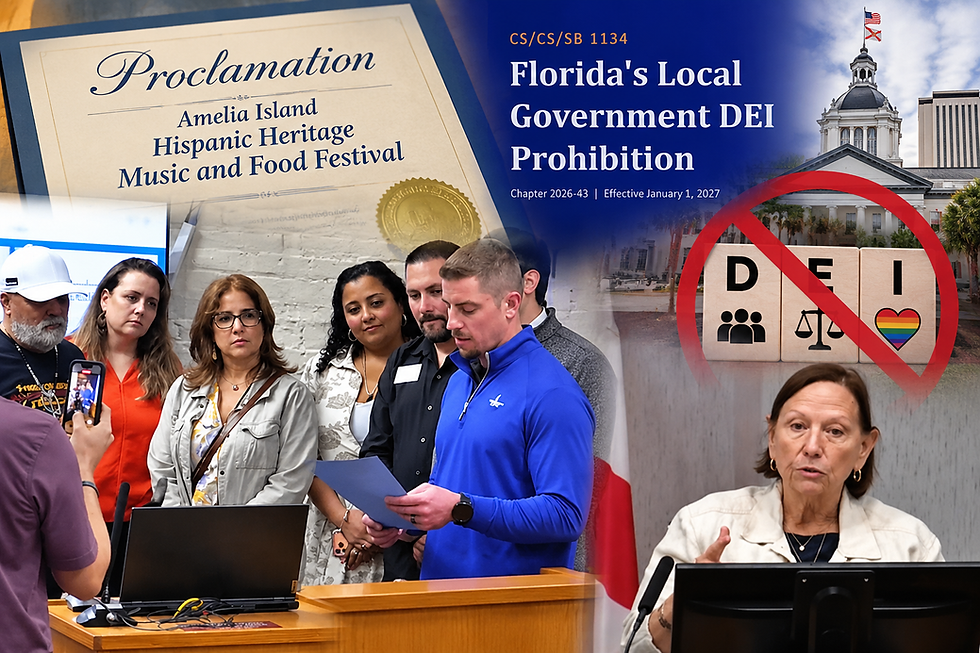
Mayor James Antun had presented a city proclamation recognizing the fifth annual Amelia Island Hispanic Heritage Music and Food Festival, being held Saturday in downtown Fernandina Beach.
The proclamation celebrated local Latino, Spanish and Hispanic cultures and traditions and said Hispanic food and music help preserve “generations of tradition, cultural identity and diversity.”
After Prince explained the new law, Commissioner Joyce Tuten asked whether the city could issue the same proclamation next year.
Prince said Hispanic Heritage Month itself can still be recognized because the new law contains exceptions for certain observances recognized under federal or state law. But she said the city may not be able to issue an event-specific proclamation like the one Antun had just presented.
“We might just have to recognize Hispanic Heritage Month and not be able to give the proclamation for this event that's happening next year,” Prince said.
Waldemar Barrero, who had stood with festival organizers as Antun presented the Hispanic Heritage proclamation minutes earlier, returned during public comment to question how the new law could affect other community events.

Barrero offered a hypothetical example of organizing an event featuring an all-girls skateboarding competition, an all-girls surfing competition, female bands and women-owned businesses.
“The city will allow me to put this event on, but the city cannot endorse it, basically is what I'm understanding,” Barrero said. “So we'll see how we can do that.”
Prince’s presentation dealt with Senate Bill 1134, which Gov. Ron DeSantis approved April 22. The legislation became Chapter 2026-43 and takes effect Jan. 1, 2027.
The legislation has direct ties to Nassau County.
Republican state Sen. Clay Yarborough of Jacksonville sponsored SB 1134. Republican state Rep. Dean Black, whose district includes Nassau County, sponsored HB 1001, the House companion measure. The House ultimately passed Yarborough’s Senate bill, while Black’s measure was laid on the table.
The Senate approved SB 1134 by a 25-11 vote March 4. The House passed it 77-37 on March 10.
Minshew pointed to the two local lawmakers during her criticism of the legislation.
“We should all be ashamed that this is what comes out of our legislature,” she said. “And the people that we elected in this county were the two sponsors of this bill.”
Minshew criticized lawmakers for spending time on the legislation rather than property taxes, insurance costs, affordable housing and homelessness.
“This is what our legislature in Tallahassee is doing instead of trying to fix property taxes and property insurance and all the other things that we struggle with, and affordability and housing and homelessness,” she said.
“Instead of working on those issues, this is what they work on,” Minshew said. “And we should all be ashamed of this because this is not what we are as Americans.”
SB 1134 prohibits counties and municipalities from funding or promoting DEI or taking official action involving DEI, including adopting or enforcing ordinances, resolutions, rules, regulations, programs and policies.
The law defines DEI as efforts to influence the composition of employees based on race, color, sex, ethnicity, gender identity or sexual orientation; provide preferential treatment or special benefits based on those characteristics; or promote training, programming or activities designed or implemented with reference to those characteristics. Equal-opportunity and equal-employment materials explaining anti-discrimination laws are excluded.
Prince said Fernandina Beach does not have a DEI officer, but the law reaches much further than DEI offices.
Existing city ordinances, resolutions, rules, programs or policies that fall within the law will become void when it takes effect. Prince said the city is reviewing its ordinances, personnel policies, employee handbooks, proclamations and other activities to determine what will have to change.
One change Prince said is clear is that the city also will no longer be able to issue a Pride Month proclamation.
“Obviously, in violation of this would now be a proclamation for a Pride Month in any manner,” Prince said.
She said bias-sensitivity training involving the six characteristics covered by the statute also could not continue, and the city could not award additional procurement points for diversity programs targeting minority-owned businesses.
Race-neutral recruiting programs remain permissible, as do programs required by federal law.
The law will also affect companies and nonprofit organizations doing business with the city.
A potential recipient of a city contract or grant must certify before receiving the contract or grant that it will not use city money to require employees, contractors, volunteers, vendors or agents to subscribe to, study or receive instruction using DEI materials as defined in the statute.
Prince said there is no minimum dollar amount for the requirement.
“It doesn't matter how small the contract is, how large it is,” she said. “That vendor has to sign, or we cannot award the contract to them.”
The city has begun reviewing procurement documents and standard bidding language in preparation for the new requirements.
The law also allows municipal residents to sue over alleged violations. A court may grant declaratory or injunctive relief, damages and costs.
For elected officials, the consequences can extend to their offices.
The statute says a member of a municipal governing body or other municipal official who violates the law while acting in an official capacity commits misfeasance or malfeasance in office. Florida law allows the governor to suspend a municipal official on those grounds.
Prince warned commissioners that a lawsuit would not have to come first.
“There doesn't have to be a court case,” she said.
The law contains no period allowing the city to correct an alleged violation before legal action can begin, Prince said.
“This law will implement immediately on January 1,” she said. “Litigation can begin from day 1.”
Minshew said the potential consequences will affect how she speaks once the law takes effect.

“It is infuriating to me that we have to sit and listen to this, and we have to comply to it,” she said. “And my personal speech will be hindered so that I don't have to worry about getting removed from office on January 1.”
“But until then, I can say what I want, and I will continue to do that,” Minshew said. “This is beyond horrible.”
Prince told commissioners they will retain their right to speak privately, including on personal social media accounts, as long as they are not acting in their official capacity.
The city attorney’s office, city manager and city clerk are reviewing city policies before Jan. 1 and will provide commissioners and employees with guidance about what remains permissible.
Prince said she wanted residents to understand why those changes will be occurring.
“We are following the law,” she said. “This wasn't by choice.”



Comments