

Minshew's Waterfront Takedown Missed the Real Problem: The Commission Failed to Lead
- Mike Lednovich
- Jun 17
- 3 min read


Commentary
By Mike Lednovich/Editor
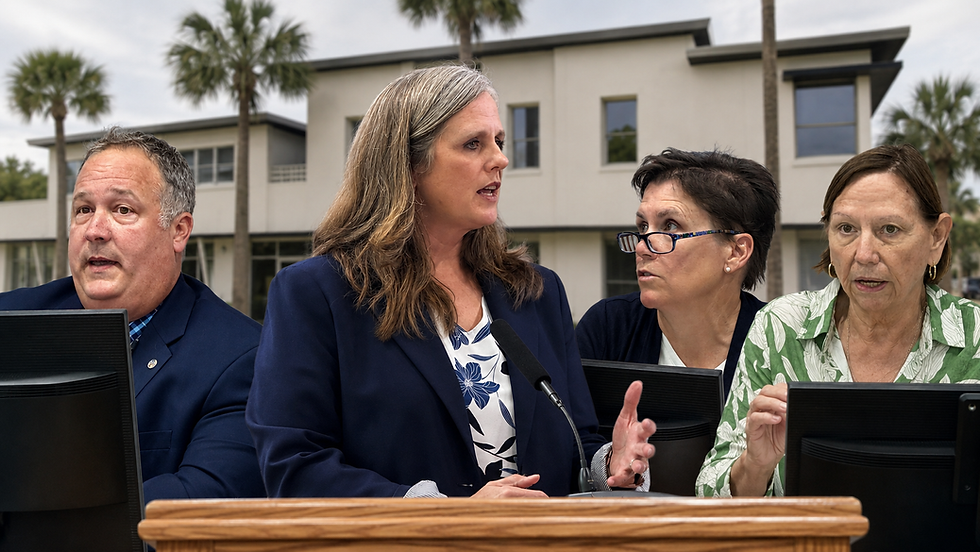
FERNANDINA BEACH — City Commissioner Genece Minshew spent nearly 20 minutes Tuesday night critiquing the Waterfront Advisory Board for what she described as a lack of focus, measurable goals, deliverables and accomplishments.
The irony was impossible to miss.
Because if the Waterfront Advisory Board appears directionless, the responsibility for that rests squarely with the City Commission.
The Waterfront Advisory Board does not operate independently. It is not a private organization setting its own priorities. It is an advisory board created by and reporting directly to the City Commission. Its mission, authority and responsibilities are defined by elected officials.
A basic principle of leadership is that leaders establish objectives, communicate expectations and provide resources and guidance necessary for success. When a team fails to understand its mission, effective leaders first ask whether they adequately communicated that mission.
That never seemed to occur Tuesday night.
Instead, Chairman Jenny Schaffer found herself repeatedly defending a volunteer board that has spent much of the past year trying to figure out what role it is supposed to play.
When Minshew asked why the board's work plan lacked specific projects, timelines and deliverables, Schaffer gave a remarkably candid answer.
"We weren't really sure how to make that different than the CRA goals and timelines that we had for that," she said. "It's almost like we didn't know exactly what was being requested from us."
That statement should have stopped the discussion cold.
If an advisory board doesn't know what is being requested of it, that is not primarily a board problem. It is a leadership problem.
Schaffer went even further.
"We definitely want anytime y'all's guidance, send us an email, things that you want us to hammer out and work on. We're hungry to hear that from you guys."
Think about that for a moment.
A volunteer advisory board chair was publicly asking city commissioners for direction.
Not once during the exchange did Minshew identify specific goals the commission had previously assigned the board. Not once did she point to a commission-approved strategic plan laying out priorities. Not once did she explain what measurable outcomes commissioners expected six months ago.
Instead, she criticized the board for failing to produce the very structure the commission itself never provided.
Minshew frequently speaks about strategic planning, measurable objectives, milestones, accountability and data-driven decision-making. Those are admirable concepts. Good organizations need them.
But leadership is more than demanding accountability from others.
Leadership begins with creating the framework that makes accountability possible.
The commission never appears to have done that.
The uncomfortable exchange suggests a board that inherited responsibilities from the former CRA Advisory Board, had new waterfront responsibilities added to its portfolio, experienced turnover, and was left trying to determine its own priorities. Schaffer described a group that selected issues "on our hearts right now" because no clear roadmap existed. A roadmap the City Commission should have provided.
That is not how effective governance works.
Commissioners cannot leave a volunteer board to operate in a vacuum for six months and then express disappointment that the results are not sufficiently strategic.
Perhaps the most revealing moment came near the end of the discussion.
Schaffer explained that city projects were moving forward without her board's involvement and that members often did not know how or when they were supposed to provide input.
"In the CRA, we were very hands-on," she said. "But lately, since we switched, it's almost like certain things (city projects) are going through."
Again, this is not evidence of a disengaged board. It is evidence of an unclear governance structure.
To her credit, Minshew ultimately thanked the volunteers and encouraged thoughtful planning. Nobody should question her desire to improve the quality of the board's work product.
But improvement starts with ownership.
The City Commission created the Waterfront Advisory Board.
The City Commission defines its mission.
The City Commission determines what success looks like.
And the City Commission is responsible for providing direction when volunteers ask for it.
If the Waterfront Advisory Board lacks focus, the commission should spend less time questioning the volunteers and more time examining its own leadership.
The board's presentation did not reveal a failure of volunteer commitment.
It revealed a failure of elected officials to clearly articulate what they wanted accomplished in the first place.
And that's a problem no advisory board can solve on its own.


Comments