

Fernandina Beach Eyes Stormwater Rate Hikes, New Debt to Fix its Aging System
- Mike Lednovich
- Apr 12
- 3 min read


By Mike Lednovich/Editor
FERNANDINA BEACH - City officials are considering a combination of rate increases, new debt, and expanded staffing to address what consultants and city staff described as growing needs in the city’s stormwater system.
At an April 7 workshop, Utilities Director Andre Desilet told city commissioners the discussion builds on earlier work identifying system deficiencies and long-term needs.
“This is the next piece for… what the department needs to accomplish our goals, and how we discuss how we get there,” Desilet said.
Consultant Ryan Smith of Raftelis Water Analytics said the city’s system faces mounting financial and infrastructure pressures.
“Right now, you all are at zero (reserves)… We (the city) don’t have a whole lot of cash in the bank,” Smith said, referring to the system’s days of cash on hand compared to an industry median of roughly 315 days.
He also noted the system’s infrastructure is older than other peer utilities.
“You’re at 22 years right now,” Smith said, compared to a 15-year median.
Much of the system dates back decades. The underlying report presented to city commissioners states, “Majority of System Installed in 1977,” with replacement costs now estimated at $52 million.
To address those needs, the city is proposing a roughly $10 million, five-year capital improvement plan focused on drainage upgrades, pipe rehabilitation, and flood mitigation projects.
Smith said funding would rely heavily on borrowing.
“What we’ve assumed is… securing a private placement loan for $3.4 million in 2027… (and) in 2029… $2.5 million,” he said.
City staff emphasized the importance of maintaining financial stability while taking on that debt.
“We’ve targeted… debt service coverage equal to or greater than 130% per year,” Smith said.
A key part of the plan is increasing maintenance capacity. Desilet said the department is now seeking three additional field workers instead of four initially proposed.
“What we’ve arrived at is that we’re requesting an addition of three field personnel… (who) will operate our vacuum truck non-stop,” he said.
The goal is to extend the life of existing infrastructure and reduce costly replacements.
“We want to try to… reach that maximum useful life of our existing infrastructure,” Smith added.
To fund operations and capital projects, the city is considering a new rate structure based on Equivalent Residential Units (ERUs), which ties fees more closely to impervious surface area.
The proposal would raise the base monthly rate.
“We’re recommending that each ERU be billed at $16.75,” Smith said, up from the current $14.36.
The restructuring would also shift more costs to commercial properties and eliminate certain discounts.
“We are recommending elimination of the private retention facility discounts,” Smith said.
City staff said those discounts currently offset less than 1% of system costs.
Officials acknowledged the changes would have uneven impacts across customer classes.
“Our existing rate structure produces inequities amongst different customer classes,” the consultant’s report states.
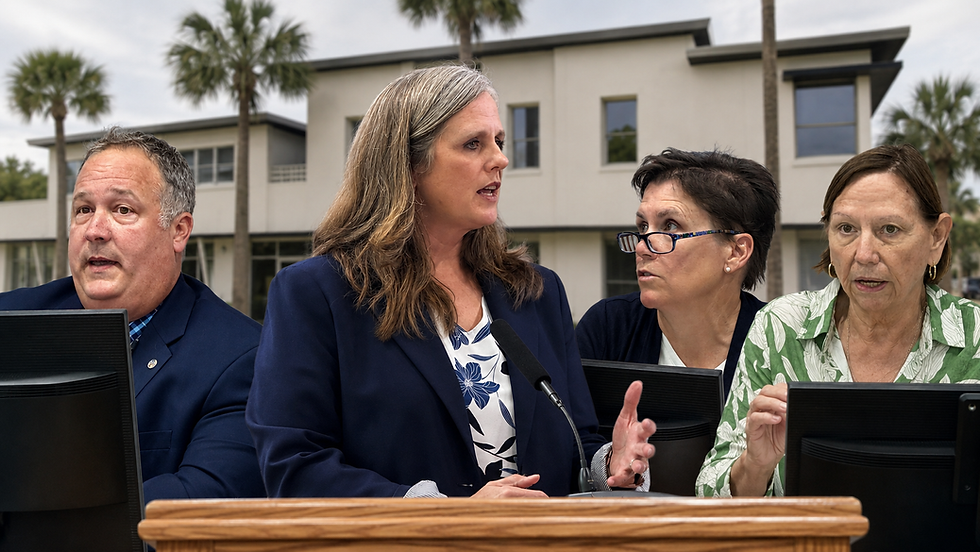
Commissioners debated how rate changes would affect residents, particularly those in smaller homes or on fixed incomes.
“I’m somewhat concerned about the increase for what I think of as really… these small properties,” Commissioner Genece Minshew said.
Others questioned whether proposed tiered pricing would accurately reflect runoff impacts.
“Square footage… doesn’t actually tell us a very accurate story,” Commissioner Joyce Tuten said.
At the same time, officials pointed to disparities in how commercial users are currently billed.
“We can really see how… undercharged commercial has been,” Desilet said.
City staff plans to return with a draft ordinance reflecting commission direction, with a target implementation date of Oct. 1, the start of the next fiscal year. The plan requires city commission approval.
“Stormwater fees are all driven by ordinance… we’ll come back with an updated ordinance that reflects this new rate structure,” Desilet said.
Officials also plan to review exemptions in the current ordinance, which has not been updated since 2012.
“This has not been changed since the original ordinance,” Desilets said.
While commissioners acknowledged the proposed increases, staff emphasized they are intended to stabilize the system for the near term.
“This will put us in a very good position,” Desilets said, though he cautioned, “new projects are going to develop… and more needs are going to arise.”


Comments